

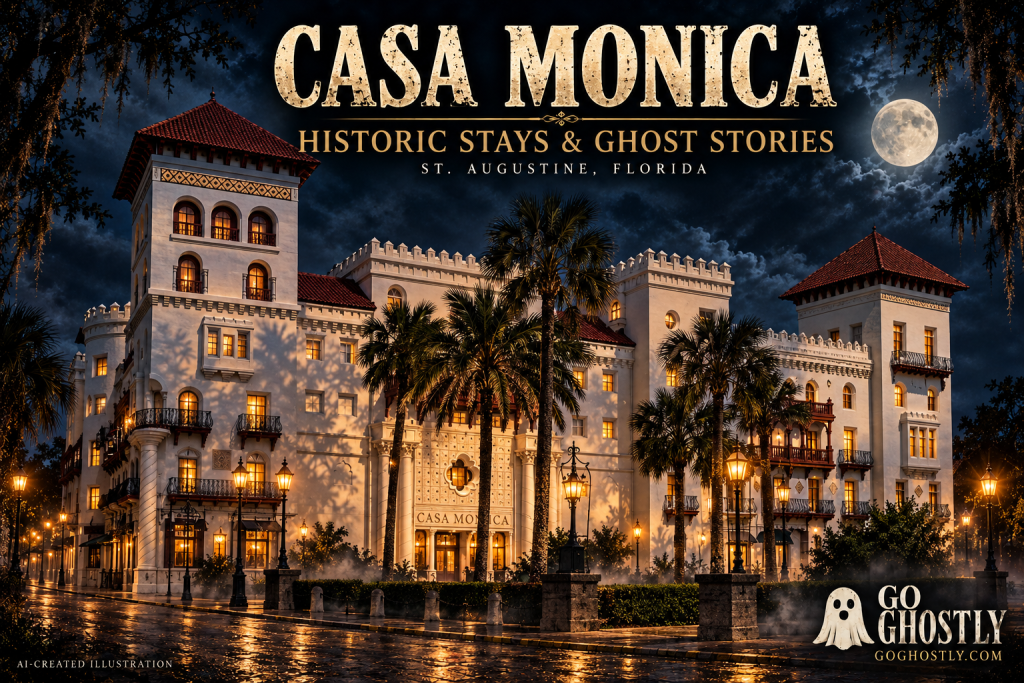

St. Augustine, Florida · Historic architecture and reported hauntings
Casa Monica Resort & Spa: Ghost Stories, History & Staying Overnight
White towers, deep balconies and an old hotel name that still follows the building: Casa Monica brings a different kind of atmosphere to a St. Augustine ghost trip.
This is a choice for travellers who want their evenings full of stories and their accommodation to feel like a substantial hotel. The building gives the visit a strong sense of place, while the city outside supplies museums, old streets and tour routes. Ghost lore adds another layer, particularly for visitors who enjoy learning what has been said about the rooms above the lobby.
Researched September 2026. Ghost stories below are attributed accounts, separate from documented hotel history. Booking links open the named provider’s website. Read our affiliate disclosure.

The ghost stories associated with Casa Monica
Casa Monica’s haunting lore concentrates on guest floors and named suites: footsteps with nobody in sight, a voice answering from an empty room, and visitors who seem dressed for a much earlier hotel season. The following are published staff and guest accounts, with links to the tellings behind them.
The fourth floor: children in an empty corridor
In FrightFind’s account, employees hear children running and laughing on the fourth floor, then look into the corridor and find it empty. The unnerving part is the mismatch between a busy-sounding hallway and the absence of anyone making the noise. The same retelling includes radios and alarm clocks switching on and sinks running unexpectedly.
These are recurring motifs in the hotel’s folklore, rather than a single encounter with a named witness and a documented date. They give the fourth floor its reputation even when no figure is seen: the supposed presence announces itself through the sounds and equipment of an otherwise ordinary hotel.
The Flagler Suite: a handprint and an answering voice
Haunted Rooms’ retelling describes a child-sized handprint appearing on the Flagler Suite’s bathroom mirror. It also recounts a sceptical housekeeper knocking before entering. Someone inside apparently responds, “We’ve been expecting you.” When she opens the door, she finds no guests.
The voice is the detail that makes this story linger. A housekeeper has followed a familiar routine and received what sounds like an ordinary reply; only the empty room changes the meaning of the exchange. The published account does not identify the speaker or establish whose spirit, if any, the story concerns.
The Ponce de Leon Suite: a radio downstairs
The same Haunted Rooms account places another disturbance in the Ponce de Leon Suite: staff working upstairs reportedly hear a radio start playing on the lower level. A woman dressed in white is also associated with the suite; the article says guests have photographed her. That is a claim in the retelling, not a photograph authenticated by Go Ghostly.
Room 411: guests from another hotel season
FrightFind describes a guest waking in Room 411 to see several men in clothing associated with the 1920s. The figures reportedly disappear before the guest can make sense of them. Unlike the corridor footsteps, this is a visual encounter: people seemingly occupying the bedroom, then abruptly gone.
Room 511: a darker story with unanswered questions
Old City Ghosts links Room 511 to an unnamed man said to have died by suicide, followed by reports of cold air and footsteps. Its account also says some housekeepers are reluctant to enter alone. The article supplies no name, date or death record to substantiate the backstory. We therefore present it as a local haunting claim, not a confirmed event in the hotel’s history.
How the stories fit together
Several ghost websites repeat closely similar versions of these encounters. Repetition helps explain how a hotel acquires a reputation, but it does not establish independent witnesses. The identifiable historical thread is the building’s changing life as Casa Monica, the Cordova Hotel and a courthouse; the identities of its supposed spirits remain much less certain.
For a visit, ask which stories staff currently share and whether a particular suite can actually be reserved. The room names are useful starting points for conversation. Guest corridors and occupied bedrooms remain private, and an evening walking tour does not include access to them.
From Casa Monica to the Cordova Hotel
Casa Monica opened on New Year’s Day in 1888, the project of Franklin W. Smith. Financial difficulties led to a sale to Henry Flagler only a few months later. Under Flagler, it became the Cordova Hotel. The building’s Moorish Revival character, towers and elaborate exterior belonged to an ambitious era of St. Augustine hotel development. Historic Hotels of America documents this history.
The hotel closed in 1932 and subsequently served as a county courthouse. Richard Kessler bought the property in 1997 and restored it to hospitality use. That sequence explains why the present hotel contains several historical identities: an early resort, a building adapted for public business and a restored place to stay.


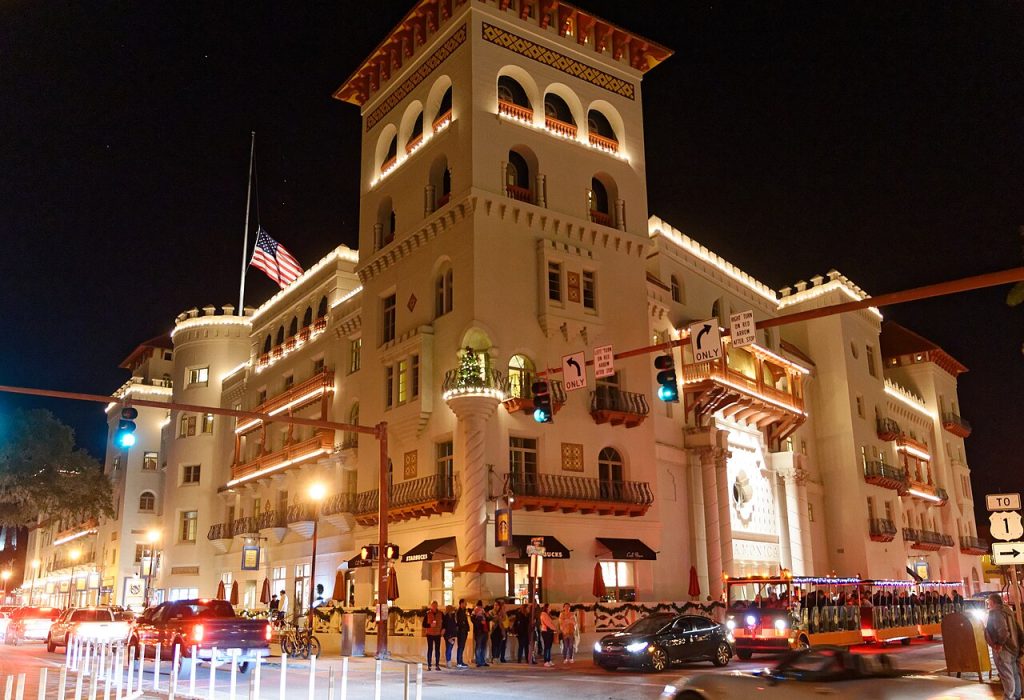
When you see the name Cordova on an old photograph, it is another chapter in this building’s history. Spend a little time comparing the towers, balconies and street setting with the modern exterior. That is a satisfying way to begin the visit before turning to accounts that are harder to establish.
The bridge that joined two hotels
One detail makes the Cordova chapter easier to picture: in 1902, Flagler connected the hotel to the neighbouring Alcazar by a bridge. It became the Alcazar Annex, part of a larger hospitality venture. The bridge was later removed. Historic Hotels of America records that connection, which explains why the buildings’ histories overlap.
The Alcazar is now home to the Lightner Museum. Its account of the former resort describes a complex organised around guest accommodation, baths and entertainment, including an indoor swimming pool, ballroom and bowling alley. The neighbourhood offered much more than bedrooms. Looking at Casa Monica alongside the former Alcazar helps you imagine a whole district arranged around the pleasures of a long holiday.
What a winter season once looked like
According to the Lightner Museum’s history of hotel life in St. Augustine, Flagler’s resorts typically operated from November through April. Wealthy visitors escaping northern winters could stay for the season. Their days included terraces, courtyards, sports and organised excursions; evenings brought substantial dinners, balls and theatrical entertainment.
That social world provides a backdrop for the old photographs. A veranda was somewhere to spend time and meet people; a ballroom could be central to the holiday. When later ghost stories describe figures dressed for another era, they borrow their atmosphere from a recognisable part of the city’s past. The historical setting can be explored without assuming the apparitions themselves have been established.
Try giving your own visit a little of that slower rhythm. Pause over a meal, look up at the building from the pavement, and leave an hour unplanned. A hotel with this much architectural character can become part of the day’s experience.

Plan a stay at Casa Monica
Compare the room and total stay cost for your dates, then choose a separately booked ghost tour. A historic hotel’s atmosphere is part of the attraction; the room layout, access and location still need to work for your trip.
Casa Monica at a glance
- Location
- 95 Cordova Street, St. Augustine, Florida.
- Historic opening
- 1888; later known as the Cordova Hotel.
- Today’s setting
- A Marriott Autograph Collection hotel with 137 guest rooms and suites.
- Best fit
- A city break combining hotel amenities, architecture and independently booked evening tours.
Choose a room for the stay you want
Marriott’s current room information describes Moroccan-inspired decoration, modern entertainment and connectivity, and suites with different layouts. The four-storey Kessler Suite is listed with three bedrooms and a kitchen. That is a very different accommodation choice from a conventional guest room.
For a couple planning to be out most of the day, start with the bed arrangement, bathroom and total price. For a group sharing a suite, ask how sleeping areas and bathrooms are distributed, whether internal stairs are involved, and how much shared space you will actually use. Square footage alone can be a poor guide to how a room feels when several people are staying together.
Marriott notes that accessible-room availability can be limited and instructs guests to select an accessible option during booking. Confirm the required bathroom features and route through the property directly. A lift in the hotel does not establish that every multi-level suite suits every traveller.


What is worth paying extra for?
Make a short list of what would actually improve your stay before comparing upgrades. A separate sitting area may matter if you expect to spend a relaxed afternoon indoors. Additional bedrooms may help friends keep different schedules. A particular view might be the attraction for someone interested in the surrounding architecture. Ask which of those features the exact room category includes.
For a short visit filled with museums and tours, a comfortable standard room may leave more of the budget for experiences. For an anniversary or a slower break, a suite and more time at the hotel might be the point of the trip. Compare the total cost across the same dates, and keep a requested room feature separate from something the booking actually guarantees.
A hotel you can spend time in
Casa Monica’s own website lists 137 rooms and suites, the Grand Bohemian Art Gallery and Cordova Coastal Chophouse & Bar. Art and decorative interiors are central to the hotel’s presentation, giving visitors a reason to look around the public spaces as well as use the room.
Marriott’s amenities information also lists an outdoor pool, fitness facilities and Poseidon Spa. Check treatment availability, charges and current opening times separately. A room reservation should not be assumed to include a spa appointment or every advertised experience.
Those facilities are most valuable when your itinerary leaves time for them. A slower afternoon at the hotel can sit comfortably between a morning exploring the city and an evening tour. If you expect to be away from breakfast until bedtime, compare whether the larger-hotel setting is worth the difference for your particular visit.
Look for the work behind the decoration
The restored interiors reward a closer look. Historic Hotels of America’s architectural account identifies hand-stencilling by local artist Tina Guarano Davis, commissioned in 2000, and describes decorative work on ceiling beams and arches. It also highlights the restaurant’s gold-leaf ceiling and Moroccan chandeliers. Those details belong to the craft of the restoration as well as the hotel’s older architectural story.
When public spaces are open to you, look at the relationship between the painted surfaces, lighting and arches. Ask staff whether an architectural tour is available during your stay and which areas it covers. Even a brief introduction can help you notice details that would be easy to walk past on the way to a lift or restaurant.
Parking, access and the full booking cost
The Marriott listing currently gives check-in as 4 p.m., check-out as 11 a.m. and a minimum check-in age of 21. It lists paid valet parking and allows pets subject to charges and restrictions. Confirm the current figures and your chosen rate’s cancellation terms on the booking page.
The hotel is in the Historic District near Flagler College, the Lightner Museum and St. George Street. Plan central sightseeing on foot when that suits your mobility and the conditions, but arrange transport separately for farther attractions.
For a useful comparison, add up the room, taxes, any mandatory charges, parking, meals and pet costs that apply to you. Check whether breakfast is included in your particular rate. Two offers with similar nightly prices can produce different totals once those items are included.
Before arrival, identify the correct vehicle entrance or drop-off point and save your reservation details. If you are attending a tour on the first evening, leave enough time to arrive, check in and reach its actual meeting point. The hotel’s address and a tour’s starting location are separate arrangements.
Pair your stay with an evening of ghost stories
Our suggested approach is to choose one tour first, then build the rest of the stay around a different daytime experience. An evening walk followed by a morning museum visit gives the stories some historical context and avoids repeating the same route several times.
| Experience | What distinguishes it | Booking link |
|---|---|---|
| Ghosts of the Old City | An all-ages, approximately 90-minute outdoor storytelling walk. Building entry is not assumed. | Check the walking tour ↗ |
| Ghosts & Gravestones | An approximately 80-minute theatrical trolley-and-walking experience with PG-13 guidance and night-time entry at the Old Jail and Potter’s Wax Museum’s Chamber of Horrors. | Check the trolley tour ↗ |
Read each operator’s current meeting point, access requirements and inclusions. These tours offer different formats; do not assume any includes access inside Casa Monica. Our St. Augustine tour comparison explains the choices in more detail, including the lighthouse’s after-dark experiences.
For a two-night visit, use the first evening for your chosen tour. Keep the following day for a historic attraction and time at the hotel, then decide whether you want another evening activity. The full St. Augustine guide includes a longer itinerary if you want to add a third day.
Put the neighbouring hotels into perspective
A visit to the Lightner Museum is a particularly useful daytime pairing. Its home is the former Hotel Alcazar, completed in 1888 and designed by Carrère and Hastings. The museum lets you connect Casa Monica’s story with another major surviving building from the same period. Check current admission and tour options before planning your day.
Give each stop a different purpose: use the museum visit to explore history and collections, your time at Casa Monica to enjoy the present hotel, and the evening tour for local storytelling. That produces a more varied trip than asking one activity to provide everything. If the building’s changing uses interest you, ask museum staff which surviving spaces best explain its life as a resort.
A stay with room to linger
On arrival day, settle in and familiarise yourself with the immediate streets before heading to the tour meeting point. Save your longer museum visit for the following morning, then return for a break. This leaves a useful gap between daytime sightseeing and the next evening’s plans, especially if different members of your group want different amounts of activity.
For a second evening, choose between another experience and enjoying the hotel itself. Dinner and an unhurried look at the illuminated exterior may be enough after a full day. Casa Monica’s appeal is that returning to your accommodation continues the atmosphere of the trip: you finish the evening inside one of the buildings you came to St. Augustine to see.
Questions before you book
Is Casa Monica still an operating hotel?
Yes. It operates as Casa Monica Resort & Spa, Autograph Collection, with room reservations available through Marriott.
Is a ghost tour included with a room?
Check the exact rate or package you select. This guide recommends separately bookable experiences and does not assume your accommodation includes a tour.
Can you book one of the suites mentioned in the stories?
Ask the hotel about the current suite name, layout, availability and room-assignment policy. A folklore reference is not confirmation of an available reservation.
How does it compare with St. Francis Inn?
Casa Monica suits a traveller who wants the larger-hotel setting. St. Francis Inn offers a smaller historic-inn experience with named rooms and its own advertised paranormal packages. Compare the actual stay you would book at each property.
Stay where the city’s history meets its stories
Choose a comfortable room, leave time for the building itself, and let an evening guide introduce the city outside.
Check Casa Monica dates and rates ↗ · Explore the Florida hotel collection · Browse all hotel guides · Explore our original 15-hotel collection